The Monkeys of Monkey Island, Panama
Which monkeys live on Monkey Island in Gatun Lake: white-faced capuchins, mantled howlers and Geoffroy's tamarins, what else you may see, and whether you can land.
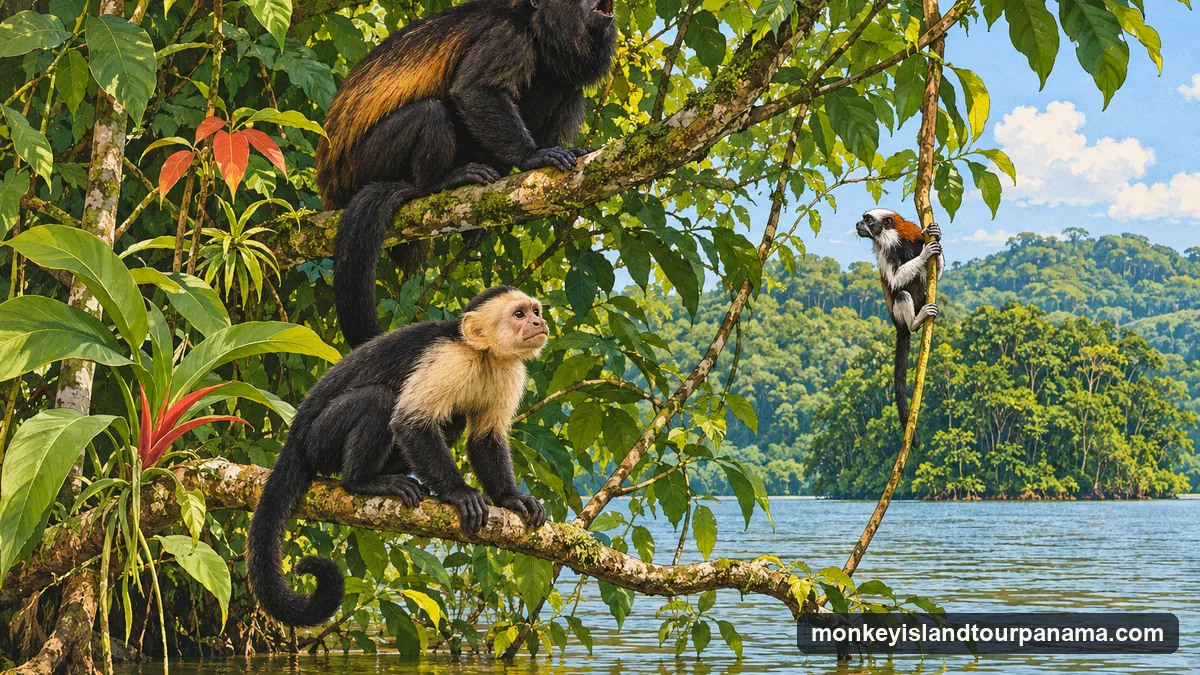
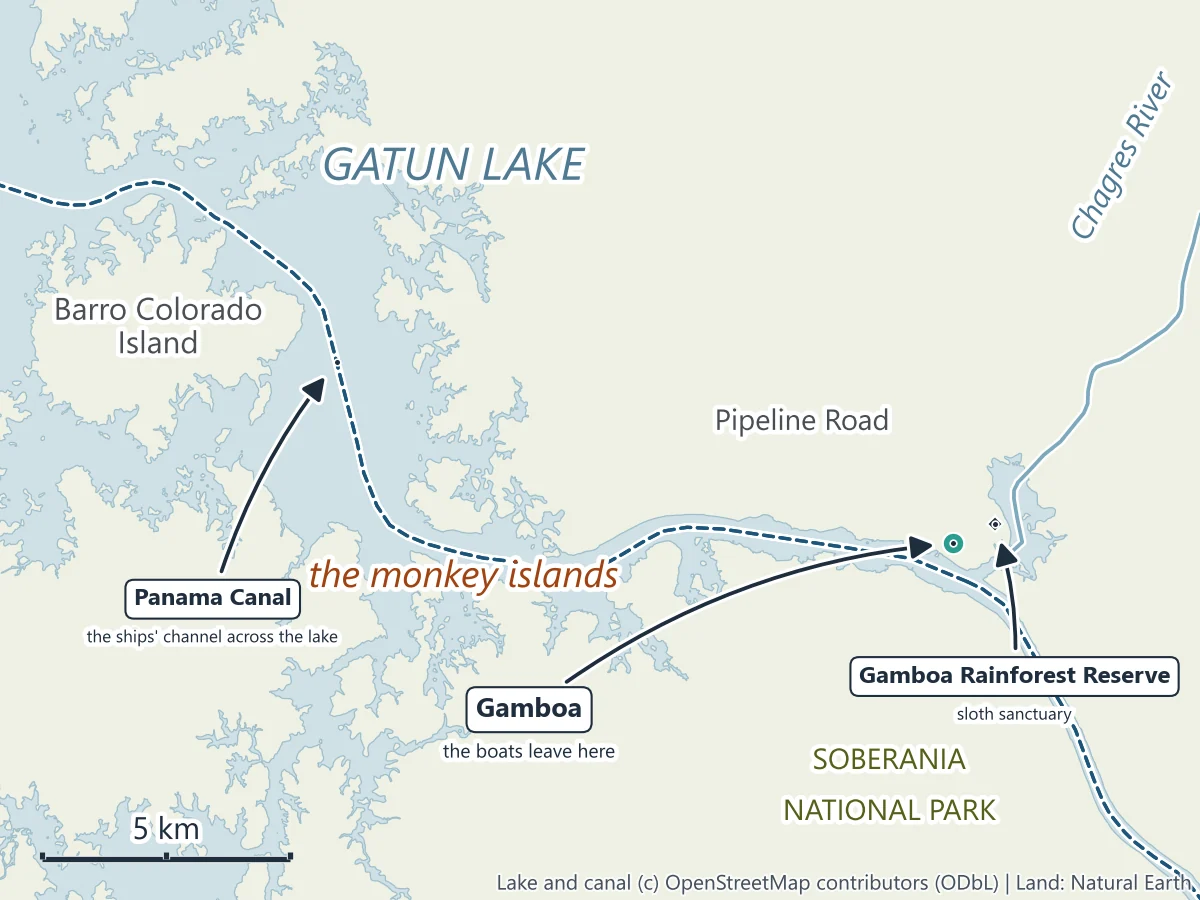
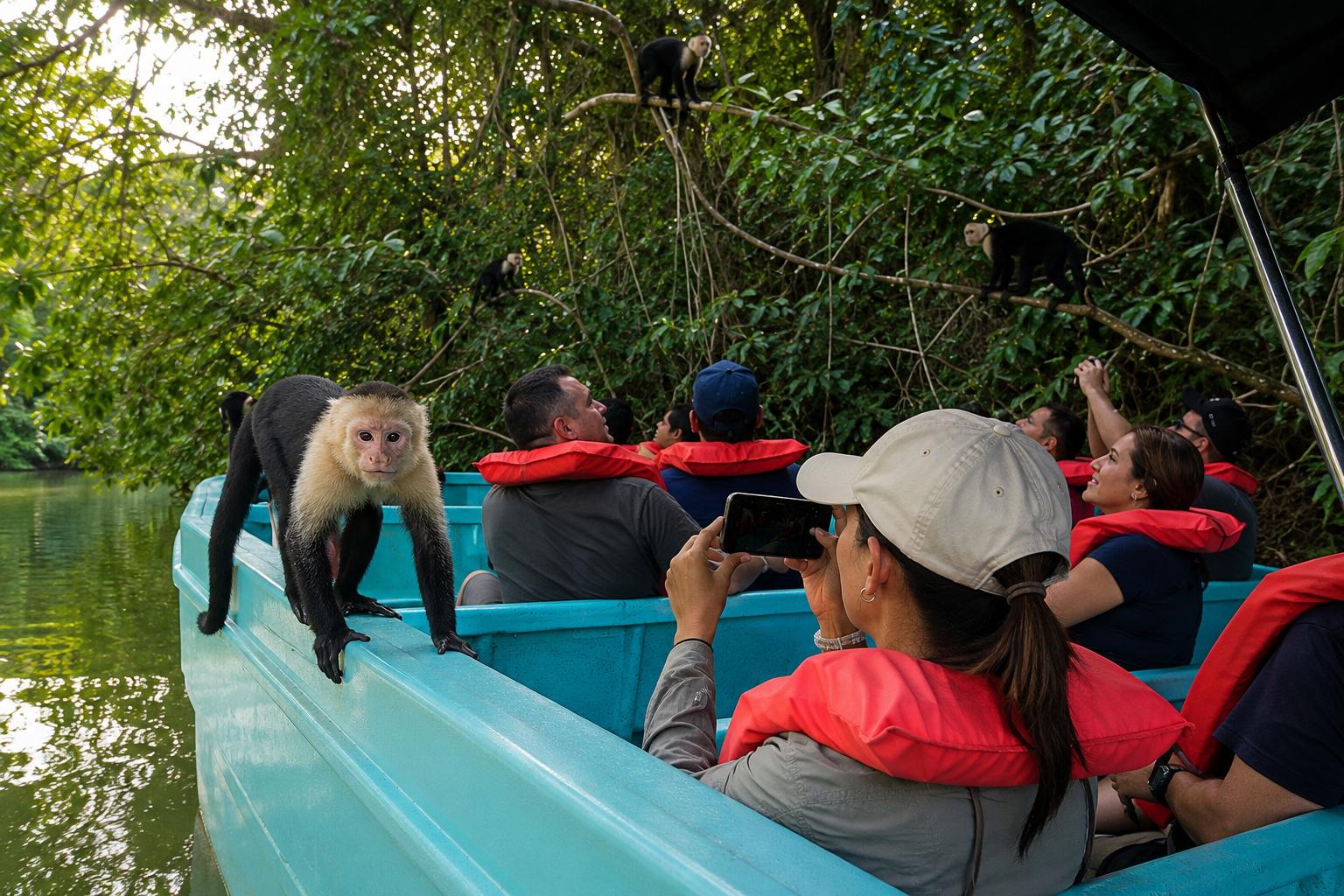
Three kinds of monkey live on the Monkey Islands of Gatun Lake: the white-faced capuchin, the mantled howler and Geoffroy’s tamarin. You watch them from the boat, at the edge of small forested islands a short ride from Gamboa; no trip here sells a landing. Sloths, crocodiles, caimans, iguanas, turtles and toucans may be around too, but nothing is guaranteed, because every animal here is wild. Panama’s national rules for visitors to protected areas, in force since May 2026, ban feeding wild animals. The tour that covers the most of this wildlife in one go is Monkey Sightseeing Panama’s canal wildlife day, from $60 a person (checked October 2026).
The three monkeys
| Monkey | Scientific name | In Spanish | What to look for |
|---|---|---|---|
| White-faced capuchin | Cebus capucinus (also classed as Cebus imitator) | Mono cariblanco | A black monkey with a cream face, throat and shoulders |
| Mantled howler | Alouatta palliata | Mono aullador | A large dark monkey with a golden-brown fringe along its flanks; the males’ roar carries across the water |
| Geoffroy’s tamarin | Saguinus geoffroyi | Mono tití | A small black-and-white monkey with a russet nape, quick and easy to miss |
All three live in the forests along the canal, and the tours to the islands name all three. A fourth canal monkey, the Panamanian night monkey (Aotus zonalis), lives in the same forests but is active at night, so a daytime boat does not count on it.
What else you may see
The trips list the same supporting cast: sloths in the shoreline trees, crocodiles and caimans on the banks, iguanas on the branches, turtles in the water, and birds such as toucans, herons, hawks and snail kites. On the canal wildlife day the safari truck around Soberania National Park looks for sloths before the boat, and on Panama A la Carte’s monkey and sloth tour a 2 km walk on Pipeline Road follows it. Pipeline Road is one of the great birding roads of the Americas: more than 300 bird species can be seen on it in 24 hours (MiAmbiente, Panama’s environment ministry).
Wild sloths are a matter of luck. If seeing one matters, the Monkey Island and sloths guide covers the tours that add Gamboa’s sloth sanctuary. The rest of the canal’s wildlife, from the crocodiles to the birds of Pipeline Road, is covered animal by animal at panamacanalwildlifetour.com.
Can you go on Monkey Island?
You watch the monkeys from the boat at the islands’ edge; no trip here sells a landing, so do not count on going ashore or touching a monkey. The one island in Gatun Lake that does take visitors is Barro Colorado, the lake’s largest at 15 square kilometres, a Smithsonian research reserve since 1923. Its guided day visits leave from the Smithsonian’s dock in Gamboa and include the boat, a hike of about three kilometres with steep sections, and lunch. They are booked with the Smithsonian Tropical Research Institute, cost $125 for a foreign adult, never run on Mondays or Fridays, and are for ages 12 and up (checked October 2026).
Check dates for the wildlife day
Who should pick something else
- You only want the monkeys: the boat-only trips cost less; see Gatun Lake boat tours.
- You want the monkeys in one morning with the locks: see the canal locks and Monkey Island.
- You want rain-free days: see the best time guide.
More Trips with Open Dates
More Panama Canal and Rainforest Tours with Open Dates
Gatun Lake, the canal locks, sloths and Embera villages, with live availability. Times and cancellation terms are on each listing.
See the Monkeys, the Sloths and the Canal
Monkey Sightseeing Panama's five-hour day: the monkey islands by boat, sloths from a safari truck and a rainforest walk, with hotel pickup.
See dates